Church of Santa Maria Della Grotta

Discover the Church of Santa Maria della Grotta in Marsala, a hidden gem nestled in the ancient Roman latomie. This rupestrian church enchants with its mystical atmosphere and medieval frescoes. Located in an area with a history dating back thousands of years, the Baroque church is carved out of an ancient hypogeum complex. A unique atmosphere that tells centuries of history, from Punic necropolis to Norman abbey. A place of worship and culture not to be missed!

The church of Santa Maria della Grotta, with its thousand-year history and cultural layers, is a must-see for anyone visiting Sicily. From Punic tombs to Byzantine decorations, every corner of this complex tells a part of the history of Marsala and the different civilizations that have inhabited it. The Baroque church, with its wide nave and dome covered in green tiles, offers a unique visual experience, while the underground frescoes testify to the importance of Greek monasticism in the region.

To arrange your own tour by reservation for tour groups or school groups on days and times other than regular openings, please send a request to the following contacts, stating the number of participants, day and time requested: 3514849420 | lilibeo@archeofficina.com

Choose a shift on the calendar

Buy your ticket

Church of Santa Maria Della Grotta

3,50 € - 5,00 €

PLEASE NOTE: We would like to remind you that the visit to the Complex of St. Mary of the Cave is bookable on weekends Oct. 11/12, 18/19 and Oct. 25/26 exclusively through the Ways of Treasures circuit. To book you can click HERE. Thank you for your attention.

DAYS AND TIMES: Saturdays and Sundays.
June through September: Saturdays 4:00 p.m. – 7:00 p.m. (last entry 6:00 p.m.) – Sundays: 10:00 a.m. – 1:00 p.m. and 4:00 p.m. – 7:00 p.m.
October through May: Saturdays 3:00 p.m. – 6:00 p.m. | Sundays 10:00 a.m. – 1:00 p.m. and 3:00 p.m. – 6:00 p.m. (guided tours every hour) (last entry 5:00 p.m.)

SUMMER DAYS AND HOURS (June to September): Saturday and Sunday.
– Saturday from 5:00 p.m. to 8:00 p.m.
– Sunday from 10:00 a.m. to 1:00 p.m. and 5:00 p.m. to 8:00 p.m.

It is possible to request opening on different days by reservation by contacting our archaeologists.

Info and reservations: Tel: 351 4849420 Email: lilibeo@archeofficina.com

SINGLE TICKET: โ‚ฌ5 full/โ‚ฌ3.50 reduced (6-18 years old, college students under 26)

SINGLE TICKET (S. Maria della Grotta+Latomy of the Niccolini+Hypogeum of Crispia Salvia): โ‚ฌ12 full/โ‚ฌ7 reduced

CONTACT
mobile: 3514849420 | email: lilibeo@archeofficina.com

The maximum number of tickets that can be purchased for the date and slot you have chosen is 0. If you'd like to purchase a larger number of tickets, try changing the date and/or slot.
Number of full tickets
0
Number of reduced tickets
0
Total
โ‚ฌ0,00

How to get to the site

Additional information

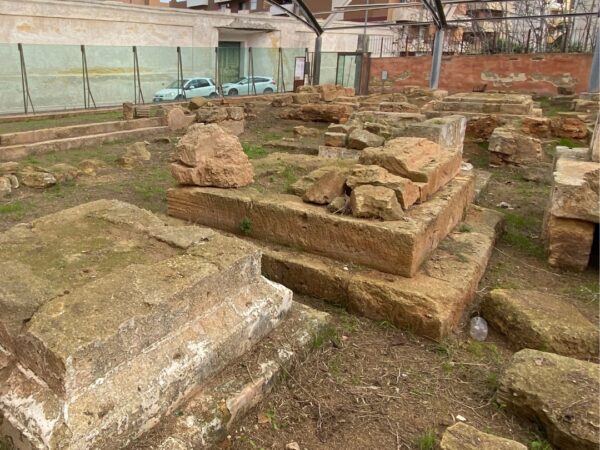
The area on which the church stands has a complex and stratified history. In Punic times, it housed a necropolis with tombs dug into the rock. During the Roman period, between the end of the second and third centuries AD, the area was used for quarrying the stone needed for the building expansion of the city of Lilybaeum, which became a Roman colony. In late Roman times, the quarries ceased activity and were turned into a cemetery area by the early Christian community, which was also used by groups of the Judaic religion, as attested by the discovery of oil lamps depicting the menorah.

Later, the area was designated for a Greek-rite abbey of the rule of St. Basil, established in 1097 by Count Roger after the Norman conquest of Sicily. The monks adapted the existing hypogea for cultic and living purposes, decorating the altars with frescoes that testify to links with Greek-Byzantine culture. Prominent among them is the Theory of Saints, still visible.

In the late 12th century, the abbey was unified with the abbey of the same name in Palermo. Several structures were built in the 15th century, including altars and underground chapels. In 1550, Charles V handed the complex over to the Jesuits, who held it until 1860. During this period, the hypogeal complex continued to be used for liturgical purposes.
In 1712, the Jesuits entrusted the church’s rebuilding project to Don Joanni Amico. The baroque, semipogean church was carved out of the underground complex and features a large single-nave hall, covered in white stucco, with a dome embellished with green tiles. Passed to the State Property Office in 1866, the church remained open for worship until 1968, when it was closed due to collapses caused by the earthquake. Today the complex is part of the Archaeological Park of Lilybaeum-Marsala.
Tours are by archaeologists from the ArcheOfficina cooperative.